There You Go Using That Weapon on Me Again
| Edwin Starr | |
|---|---|
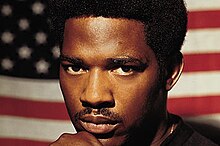 | |
| Background information | |
| Birth proper noun | Charles Edwin Hatcher |
| Built-in | (1942-01-21)Jan 21, 1942 Nashville, Tennessee, U.S. |
| Died | April two, 2003(2003-04-02) (aged 61) Chilwell, Nottinghamshire, England |
| Genres | Soul, R&B, funk, disco, psychedelia |
| Occupation(southward) | Vocalist, songwriter |
| Years active | 1962–2003 |
| Labels | Ric-Tic, Motown, 20th Century, Motorcity |
| Associated acts | The Future Tones, Blinky Williams |
| Website | edwinstarr |
Edwin Starr (built-in Charles Edwin Hatcher; January 21, 1942 – April 2, 2003)[1] was an American vocalizer and songwriter. Starr was famous for his Norman Whitfield-produced Motown singles of the 1970s, most notably the number-one hit "War".[ii]
Starr was born in Nashville and raised in Ohio, and later on lived in Detroit while singing for Ric-Tic and Motown Records. He was backed by the band that would become known equally "Black Merda". Hawkins and Veasey of the group played on most of his early on hits on the Ric Tic Characterization. Starr's songs "Twenty-Five Miles" and "Stop the War Now" were also major successes, in 1969 and 1971 respectively. In the 1970s Starr'south base of operations shifted to the United Kingdom, where he connected to produce music, and resided until his death.
Early on life [edit]
Charles Edwin Hatcher was born in Nashville, Tennessee, in 1942.[1] He and his cousins, soul singers Roger and Willie Hatcher, moved to Cleveland, Ohio, where they were raised.
In 1957, Starr formed a doo-wop group, the Future Tones, and began his singing career. He got his showtime big interruption making an appearance on American TV'south The Uncle Jake Testify, where he performed alongside Billie Holliday. Starr lived in Detroit in the 1960s and recorded at first for the minor Ric-Tic label, part of the Gilded World recording company, and later for Motown Records (nether the Gordy Records imprint), subsequently the latter captivated Ric-Tic in 1968.
The song that launched his career was "Agent Double-O-Soul" (1965), a reference to the James Bond films, already pop at the time. Other early hits included "Headline News", "Back Street", and "Southward.O.S. (Stop Her on Sight)". While at Ric-Tic, he wrote the vocal, "Oh, How Happy", a #12 Billboard Hot 100 hit in 1966 for The Shades of Blue (he would proceed to release a version of the song with Blinky in 1969) and sang lead for the Holidays on their #12 R&B hit, "I'll Love You Forever". At Motown he recorded a cord of singles before enjoying international success with "Twenty-Five Miles", which he co-wrote with producers Johnny Bristol and Harvey Fuqua. Information technology peaked at #6 in both the Hot 100 and R&B Charts in 1969.[2]
It was when Motown's Berry Gordy became frustrated with smaller labels similar Ric-Tic stealing some of the success of his company that he bought out the characterization. Many of Starr's Ric-Tic songs (subsequently owned by Motown) similar "Back Street" and "Headline News" became favored northern soul classics. His early Ric-Tic hit "Stop Her on Sight (S.O.Southward.)" was reissued in U.k. (with "Headline News" as its B-side) in 1968, and information technology performed better than the original release on the Britain Chart, surpassing the original #35 and peaking at #xi.[3] His 1970 song "Time" besides helped to institute him as a prominent artist on the northern soul scene.
Career [edit]
The biggest hit of Starr'due south career, which cemented his reputation, was the Vietnam War protestation song "State of war" (1970). Starr's intense vocals transformed a Temptations anthology rails into a number one chart success, which spent three weeks in the pinnacle position on the U.S. Billboard charts, an anthem for the antiwar move and a cultural milestone that continues to resound in movie soundtracks and hip hop music samples. It sold over three million copies, and was awarded a gold disc.[4] "War" appeared on both of Starr'south War & Peace anthology and its follow-upwardly, Involved, produced by Norman Whitfield. Involved besides featured another song of like construction titled "Stop the State of war At present", which was a small-scale hitting in its ain right. Music critic Robert Christgau called the latter album "Norman Whitfield's peak production".[5] His backing singers during this time were Full Concept Unlimited, who later became Rose Royce.
Starr continued to tape, about notably the song "Hell Upwardly in Harlem" for the 1974 motion-picture show Hell Up in Harlem, which was the sequel to Blackness Caesar, an earlier hit with a soundtrack by James Brown. In 1979, Starr reappeared on the charts with a pair of disco hits, "(Eye-to-Eye) Contact" and "H.A.P.P.Y. Radio". "Contact" was the more successful of the two, peaking at #65 on the US pop charts, #13 on the R&B chart, #ane on the dance chart, and #half-dozen on the UK Singles Chart.[3] "H.A.P.P.Y. Radio" was besides a top 10 hitting in the United kingdom of great britain and northern ireland, reaching #ix on the chart in mid-1979. Past now, he had joined the well-established disco boom and had further singles on 20th Century Records. Over the years, he released tracks on a diversity of labels, including Avatar, Calibre, 10 Records, Motown (a render to his former label for a 1989 remix of "25 Miles"), Streetwave (where he recorded 1984's "Marvin", a tribute to Marvin Gaye) and Hippodrome (a sectionalisation of Peter Stringfellow's Hippodrome nightclub). His Starr café empire nevertheless enjoys success in and around Essex.
In 1985, Starr released "It Ain't Off-white". Despite garnering the attention of many in the soul and dance clubs, it vicious short of becoming a major hit (managing a #56 on the UK Charts). "It Own't Fair", along with several other singles released around the same time, would subsequently appear on Starr'south Through the Grapevine album, which was non released until 1990. Starr appeared on the charity number one single "Permit It Be" past Ferry Aid in 1987. Afterward that year, Starr teamed up with the Stock, Aitken and Waterman production visitor for the gild hit "Whatever Makes Our Love Grow". In 1989, a number 17 UK hit past the Cookie Crew chosen "Got to Keep On" sampled a portion of "25 Miles".[half dozen] This track was and then featured on a 1990 dance medley fabricated for the BRIT Awards, which made number 2 in the UK Singles Chart.[vii] A social club mix of various artists, it included the previous years remix of "25 Miles".
In 1989, Starr also joined Ian Levine'due south Motorcity Records, releasing half dozen singles and the anthology Where Is the Sound, as well as co-writing several songs for other artists on the characterization. Starr resurfaced briefly in 2000 to squad up with the UK band Utah Saints to tape a new version of "Funky Music Sho' 'Nuff Turns Me On". He appeared once again in 2002 to record a song with the British musician Jools Holland, singing "Snowflake Boogie" on Kingdom of the netherlands's compact disc More Friends; and to record another rails with Utah Saints, a then-far-unreleased version of his number one striking "War"—his last recording.
In 1995, Starr featured in Blue Juice, a 1995 British drama picture show as a soul singer named Ossie Sands. The songs featured were recorded by Starr for the motion-picture show. The film has the added attraction of beingness possibly the outset film to include Northern Soul as a sub-plot.[8]
In late 2002, Edwin Starr appeared with many R&B stars on the "Rhythm, Love, and Soul" edition of the PBS series American Soundtrack. His operation of "25 Miles" was included on the accompanying alive album that was released in 2004.
Starr remained a hero on England'due south northern soul circuit and moved to England in 1983, continuing to alive there for the residual of his life. He based himself in the English Midlands, living for many years at Pooley Hall at Polesworth, Warwickshire, before moving to Bramcote in Nottinghamshire[one] [9]
Edwin Starr was inducted into the inaugural class of the Official Rhythm & Dejection Music Hall of Fame at Cleveland State University in August 2013.
Starr was inducted into the Michigan Rock and Roll Legends Hall of Fame in 2017.[10]
Death [edit]
Starr died on April two, 2003, from a eye attack. He was 61.[1] He is buried at Wilford Hill Cemetery in Nottingham.[9]
Discography [edit]
Albums [edit]
Singles [edit]
| Year | Unmarried[xiii] | Chart positions | Certifications | ||||
|---|---|---|---|---|---|---|---|
| U.s. Pop [14] | Usa R&B [15] | U.s.a. Dance [12] | AUS [11] | Great britain [16] | |||
| 1965 | "Agent Double-O-Soul" | 21 | viii | – | – | – | |
| "Back Street" | 95 | 33 | – | – | – | ||
| 1966 | "Cease Her on Sight (South.O.S.)" | 48 | 9 | – | – | 35 | |
| "I'll Beloved You Forever" (with the Holidays) | 63 | seven | – | – | – | ||
| "Headline News" | 84 | – | – | – | 39 | ||
| 1967 | "Girls Are Getting Prettier" | – | – | – | – | – | |
| "You're My Mellow" | – | – | – | – | – | ||
| "I Desire My Babe Back" | 120 | – | – | – | – | ||
| 1968 | "I Am the Man for You Baby" | – | – | – | – | – | |
| "Way Over There" | – | – | – | – | – | ||
| "Stop Her on Sight (S.O.S.)" / "Headline News" (reissue) | – | – | – | – | 11 | ||
| 1969 | "Twenty-Five Miles" | 6 | six | – | – | 36 | |
| "I'm Still a Struggling Man" | 80 | 27 | – | – | – | ||
| "Oh How Happy" (as Blinky & Edwin Starr) | 92 | – | – | – | – | ||
| 1970 | "Time" | 117 | 39 | – | – | – | |
| "War" | ane | 3 | – | 37 | 3 |
| |
| "Stop the War At present" | 26 | five | – | – | 33 | ||
| 1971 | "Funky Music Sho' 'Nuff Turns Me On" | 64 | 6 | – | – | – | |
| 1972 | "Who Is the Leader of the People" | – | – | – | – | – | |
| 1973 | "There You Go" | 80 | 12 | – | – | – | |
| "You've Got My Soul on Fire" | – | 40 | – | – | – | ||
| 1974 | "Ain't It Hell Upwards in Harlem" | 110 | – | – | – | – | |
| "Big Papa" | – | – | – | – | – | ||
| "Who's Right or Wrong" | – | – | – | – | – | ||
| 1975 | "Hurting" | – | 25 | – | – | – | |
| "Stay with Me" | – | 51 | – | – | – | ||
| "Abyssinia Jones" | 98 | 25 | – | – | – | ||
| 1976 | "Blow" | – | – | – | – | – | |
| 1977 | "I Only Wanna Do My Thing" | – | 94 | 28 | – | – | |
| 1978 | "I'm So into You lot" | – | – | – | – | – | |
| 1979 | "Contact" | 65 | xiii | 1 | 37 | 6 |
|
| "H.A.P.P.Y. Radio" | 79 | 28 | 7 | 54 | 9 | ||
| "Information technology's Called the Rock" | – | – | – | – | – | ||
| "Tell a Star" | – | – | – | – | – | ||
| 1980 | "Stronger" | – | – | – | – | – | |
| "Boop Boop" | – | – | – | – | – | ||
| "Go Up, Whirlpool" | – | – | – | – | – | ||
| 1981 | "Sweet" | – | – | – | – | – | |
| 1983 | "I Wanna Have You lot Home" | – | – | – | – | – | |
| "Polish" | – | – | – | – | – | ||
| 1984 | "Marvin" | – | – | – | – | – | |
| 1985 | "It Ain't Fair" | – | – | – | – | 56 | |
| "Missiles" | – | – | – | – | – | ||
| 1986 | "Grapevine" | – | – | – | – | – | |
| "Soul Vocalist" | – | – | – | – | – | ||
| 1987 | "Whatever Makes Our Love Grow" | – | – | – | – | – | |
| 1988 | "Long Line of Lovers" | – | – | – | – | – | |
| 1989 | "25 Miles '89" | – | – | – | – | – | |
| 1990 | "She'due south The I" | – | – | – | – | – | |
| "Own't No Stopping The states Now" (with David Saylor) | – | – | – | – | – | ||
| 1992 | "Darling Darling Baby" | – | – | – | – | – | |
| 1993 | "State of war" (as Edwin Starr and Shadow) | – | – | – | – | 69 | |
| 1994 | "Can't Stop Thinking About You" | – | – | – | – | – | |
| "–" denotes releases that did non chart. | |||||||
References [edit]
- ^ a b c d Laing, Dave (April 4, 2003). "Obituary: Edwin Starr". The Guardian . Retrieved December 5, 2017.
- ^ a b "Edwin Starr Superlative Songs / Chart Singles Discography". Music VF . Retrieved Jan 2, 2022.
- ^ a b Roberts, David (2006). British Hit Singles & Albums (19th ed.). London: Guinness Globe Records Limited. p. 524. ISBN1-904994-10-v.
- ^ Murrells, Joseph (1978). The Book of Gilded Discs (second ed.). London: Barrie and Jenkins Ltd. p. 286. ISBN0-214-20512-6.
- ^ a b Christgau, Robert (1981). "Consumer Guide '70s: S". Christgau's Record Guide: Rock Albums of the Seventies. Ticknor & Fields. ISBN089919026X . Retrieved March 12, 2019 – via robertchristgau.com.
- ^ Warwick, Neil; Kutner, Jon. The Complete Book of the British Charts: Singles and Albums. Chocolate-brown, Tony. Omnibus Press. p. 261. ISBN1-84449-058-0.
- ^ "Retrochart for March 1990". everyHit.com. Retrieved August 25, 2015.
- ^ "Soul Source, "Bluish Juice Review from 90s"". Dec vi, 1997. Archived from the original on August 15, 2020. Retrieved Feb 25, 2021.
- ^ a b "Soul fable Edwin Starr's band and brother Angelo coming to The Dark Owl in Birmingham". Birmingham Mail. July 31, 2015. Retrieved January 30, 2021.
- ^ "Michigan Rock and Gyre Legends - EDWIN STARR". Michiganrockandrolllegends.com . Retrieved July 9, 2019.
- ^ a b Kent, David (1993). Australian Chart Book 1970–1992 (illustrated ed.). St Ives, N.S.W.: Australian Chart Book. p. 291. ISBN0-646-11917-6.
- ^ a b c "Edwin Starr - Awards". AllMusic. Archived from the original on October 20, 2012. Retrieved Jan 2, 2022.
- ^ "The Official Edwin Starr website". Edwinstarr.info. Archived from the original on August 15, 2015. Retrieved August 25, 2015.
- ^ Whitburn, Joel (2003). Top Pop Singles 1955–2002 (1st ed.). Menomonee Falls, Wisconsin: Tape Research Inc. p. 672. ISBN0-89820-155-1.
- ^ Whitburn, Joel (1996). Meridian R&B/Hip-Hop Singles: 1942–1995. Record Research. p. 418.
- ^ Betts, Graham (2004). Complete United kingdom Hitting Singles 1952–2004 (1st ed.). London: Collins. p. 92. ISBN0-00-717931-6.
- ^ "Edwin Starr - War". bpi.co.u.k. . Retrieved January 15, 2022.
- ^ "Edwin Starr - Contact". bpi.co.great britain . Retrieved January fifteen, 2022.
External links [edit]
- Official site
- Edwin Starr at IMDb
- Edwin Starr discography at Discogs
- Edwin Starr interview past Pete Lewis, 'Blues & Soul' x/92
- Edwin Starr at AllMusic
- "Edwin Starr". Find a Grave. Retrieved September iii, 2010.
- BBC report on his latter years in England, October 24, 2013

mofflinponesisforty.blogspot.com
Source: https://en.wikipedia.org/wiki/Edwin_Starr
0 Response to "There You Go Using That Weapon on Me Again"
Post a Comment